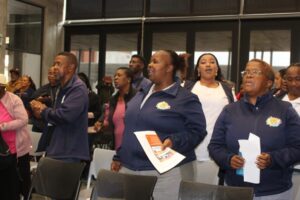
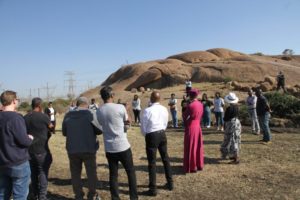
The debate on basic income support has gained new urgency in South Africa, with civil society leaders, activists, economists and unemployed young people warning that the current R370 social relief of distress (SRD) grant does not uphold the constitution’s promise of dignity, equality, and justice. Speaking at a series of policy dialogues hosted at the Nelson Mandela Foundation, participants argued that the country does not only need a universal basic income grant (UBIG), but that South Africa can afford it – and that the long-term cost of poverty far outweighs the cost of meaningful income support.
Nomahlubi Khwinana from the South African Human Rights Commission (SAHRC) raised concerns about the adequacy of the R370 grant, saying that it does not meet even the most basic needs required for a dignified life. She explained that the dialogue focused on whether the grant is sufficient to give effect to constitutional values, and the conclusion, according to her, was that it does not.
The SRD grant recipients at the meeting revealed that they are often forced to make impossible choices. One of them said that they chose to stop travelling to work opportunities altogether to use the R370 solely to buy food.
Commissioner Khwinana emphasised that continued poverty and deprivation undermine constitutional promises, noting that Constitutional Court jurisprudence has repeatedly affirmed the state’s obligation to progressively realise socio-economic rights. She stressed that policy failure in this area is not merely a technical issue, but a human rights concern that directly affects dignity and equality.
Former statistician-general, Dr Pali Lehohla, strongly endorsed the introduction of a UBIG, saying that South Africa has both the fiscal space and economic rationale to implement it. He pointed to research presented at the dialogue showing that a basic income grant would generate a multiplier effect, meaning that every rand invested could significantly stimulate broader economic activity.
As an example, Dr Lehohla cited Statistics South Africa’s 2022 Income and Expenditure Survey, explaining that the introduction of the R350 grant contributed to a sharp increase in black household expenditure – from 42% in 2016 to over 62% by 2022. “This shows that when poor households receive income, they spend it immediately in the real economy on food, transport, and local services,” he said. However, Dr Lehohla argued that poor policy design limited the grant’s full impact, particularly its failure to align with industrial and agricultural strategies that could boost local production and job creation.

The lived reality of unemployment was powerfully illustrated by 27-year-old Tshego Matsa, who described surviving on the R370 grant. Matsa explained that unemployment is not only an economic crisis but a mental health crisis, as social expectations to be self-sufficient clash with the reality of having no income. Even basic job-seeking costs, such as transport to interviews, suitable clothing, or printing a CV, are often unaffordable, trapping many young people in long-term unemployment and emotional distress.
Basetsena Meletse, founder of the Passover Community Building Organisation, and an Amandla.mobi member, said an UBIG would restore dignity and reduce the daily humiliation experienced by unemployed people. He shared examples of individuals pretending to be intoxicated simply to avoid being questioned about their job status. According to Meletse, regular income would improve mental well-being, reduce anger and frustration, and enable people to start or expand small businesses. Drawing from his own background as a trader, he said an UBIG could help pass entrepreneurial skills to future generations and improve food security by ensuring households can reliably afford meals each month.
Koketso Moeti, executive director of Amandla.mobi, said South Africa has no time to lose in addressing poverty. She argued that income support is essential to restoring the inherent dignity of every human being and that implementing a UBIG would demonstrate real political commitment to collective well-being. “This is the only meaningful way forward,” she said, adding that the benefits would extend to individuals, households, communities, and the country as a whole, said Moeti
Isobel Frye, senior policy advisor at Oxfam South Africa, warned that the failure to implement a basic income grant risked deepening inequality, hunger, and social unrest. With unemployment at around 42%, and even higher in rural provinces, she said many communities suffer from a lack of income circulation, leaving local economies stagnant. Frye explained that a universal grant set at the upper-bound poverty line, adjusted for inflation, and taxed back from higher earners through what she called inverse targeting, would revitalise township and rural economies, stimulate small businesses, and strengthen democracy.
Frye observed that the common thread tying all contributions to the dialogue was that South Africa cannot afford to continue with an inadequate and exclusionary income support system. Participants called for urgent political will, engagement with parliament and national treasury, and policies that are relevant to the lived realities of the poor. The conclusion was unequivocal: universal basic income is evidence-based, affordable, and essential to restoring dignity, social stability, and inclusive economic growth in South Africa, said Frye.