
Who controls the food system controls the future

Walk into any major supermarket in South Africa, and the shelves seem to tell a story of abundance: aisles of bread, meat, dairy, fruit, vegetables, cereals, snacks, and processed foods wrapped in the language of choice, convenience, and modernity. This food system is often held up as a model for the rest of the continent: modern farms, sophisticated logistics, powerful processors, dominant retailers, and the capacity to produce, import, export, and distribute food at scale.
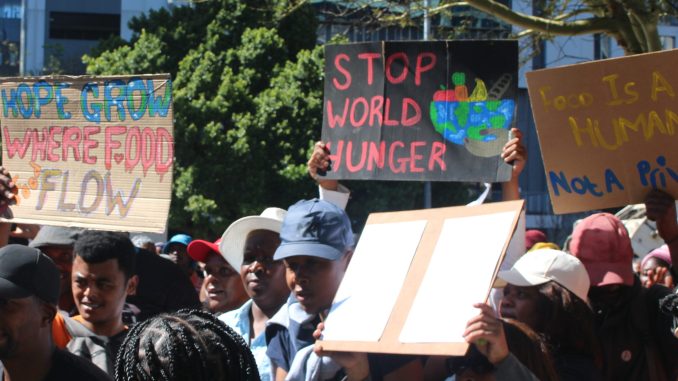
Yet behind this display of plenty lies a brutal contradiction. Millions of working-class people are hungry, food prices are punishing, and child malnutrition and diet-related disease persist. While farm and food workers labour under exploitative, insecure, and often dangerous conditions, small-scale farmers struggle to survive.
The African Centre for Biodiversity’s (ACB’s) new report, The architecture of control: corporate power, financialisation, and democratic food futures in South Africa, argues that this is primarily a problem of power. It is about who owns, controls, and profits from the food system; how corporate concentration shapes production, prices, markets, labour, and consumption; and how the state has retreated from its constitutional duty to guarantee the right to food, leaving corporations and financiers to decide what food future is possible.
Across the chain, fewer companies control more.
- Bayer/Monsanto, Corteva, Syngenta and BASF shape seeds and agrochemicals.
- Omnia, Kynoch, Nutri Feeds, Meadow Feeds, AFGRI, Senwes, VKB, and NWK influence fertilisers, feed, grain trading, and storage.
- Astral, RCL Foods, Rainbow, Tiger Brands, Premier, Pioneer Foods, Clover, Lactalis, Nestlé, and PepsiCo dominate poultry, meat, dairy, milling, baking, and processed foods.
- Shoprite, Pick ‘n Pay, Woolworths, and SPAR decide what reaches shelves and on what terms.
They are not one cartel, but coordinate through contracts, procurement, standards, credit, logistics, cold chains, storage, advertising, data, and finance. Together, they create an hourglass-shaped food system: millions of producers and consumers squeezed through a narrow corporate middle.
How control works
Control no longer depends only on owning land or factories. It operates through storage silos, ports, cold chains, procurement systems, retail shelves, credit, contracts, standards, intellectual property, data systems and digital platforms – the bottlenecks farmers, workers, traders and consumers must pass through.
When corporations control these bottlenecks, they set the terms:
- which seeds are available,
- which inputs farmers must buy,
- which standards producers must meet,
- which products reach shelves, which prices are paid, and
- which risks are pushed down the chain.
For workers, this architecture is lived as class discipline. Farm workers – shaped by apartheid land and labour legacies – remain tied to low wages, seasonal contracts, insecure housing, pesticide exposure, and weak protection. Workers in processing, logistics, retail, and fast-food face casualisation, labour broking, outsourcing, speed-ups, surveillance, and anti-union pressure, while corporations use procurement, pricing, and contracts to push costs and risks down the chain. The workers who grow, pack, transport, cook, and sell food are forced to buy it back at prices they can barely afford. This is not simply ‘precarious work’; it is a political economy of extraction built on cheap labour, racialised inequality, and fragmented working-class power.
Hunger in a system built for profit
The dominant story says hunger is caused by too little production, and that the answer is more technology, bigger farms, more chemicals, and more private investment. Another version blames poor people themselves – as if hunger were a private failure rather than the result of land dispossession, racialised capitalism, low wages, unemployment, debt, spatial apartheid, and the erosion of public support.
Hunger exists alongside abundance because food is organised as a commodity before it is protected as a right. This is also a political indictment of the state. By retreating from public provisioning, weakening public capacity, and outsourcing food security to markets, the state has abandoned its constitutional obligations and helped create the space for corporate rule over food.

Financialisation deepens the crisis
Corporate concentration now combines with financialisation: food is treated less as a way to feed people than as a field for investment and returns. Land, grain, logistics, retail, data, and even climate risks become assets, giving investors and asset managers influence over what is produced, how workers are treated, what farmers are paid, and what consumers can afford.
This contradiction reaches into workers’ deferred wages. The Government Employees Pension Fund has more than 1.267-million active members and over R2.69-trillion in assets invested through the Public Investment Corporation. Workers formally hold a stake through pensions yet have little democratic control over whether those funds reinforce the food system that squeezes them.
Digital control is the new frontier
Digital platforms, data systems, artificial intelligence (AI), precision agriculture, and automated logistics add another layer of control. Marketed as neutral modernisation, they can lock farmers into proprietary systems that monitor workers, shape prices and procurement, and make public institutions dependent on private data and infrastructure.
What must change?
We cannot wait for competition policy, consumer choice, or voluntary corporate responsibility to fix this crisis. The concentration of power in South Africa’s food system is structural – and structural power must be met with organised social power.
The right to food must be treated as a public and constitutional obligation – not a market opportunity. The state must end its dereliction and rebuild public capacity in agriculture, nutrition, storage, procurement, research, extension, seed systems, and local markets, and be accountable to people and ecosystems rather than corporate expansion.
Key food infrastructures – storage, logistics, procurement, retail, finance, and data – must be brought under public, worker, and community oversight. Workers, small-scale farmers, informal traders, consumers, and communities must have real power in food policy, investment, and institutions.
Agroecology, seed sovereignty, local food economies, and public procurement must be strengthened as practical alternatives to corporate dependence. These are not marginal add-ons; they are foundations for food systems rooted in democracy, ecological care, and people’s needs.
Above all, organised workers must step forward with urgency. The food system rests on the labour of farm workers, factory workers, truck drivers, retail workers, informal traders, care workers, and communities. Trade unions, farm worker movements, service workers, informal workers, women’s organisations, youth formations, and food sovereignty movements can build the power to confront corporations and financiers profiting from hunger, low wages, and insecurity. Decent work, living wages, safe workplaces, collective bargaining, land justice, and the right to food form one working-class struggle for democratic control over the economy and the conditions of life.

Food democracy is a class question
The food system is often treated as a technical sector managed by experts, corporations, and policy elites. But food is political. It is about land, labour, wages, public health, ecological survival, gendered care work, racialised inequality, state responsibility, and democratic power. A society where millions go hungry while corporations accumulate profits is not suffering from a lack of innovation. It is suffering from a crisis of justice.
For working-class activists, the message is clear: food must be reclaimed from corporate control and state neglect. We need alliances across workplaces, farms, communities, schools, clinics, informal markets and social movements to force a different food future: one based on rights, solidarity, ecological care, public responsibility, and democratic control from below.
Access the briefing paper here.
Mariam Mayet is the executive director of programmes for the African Centre for Biodiversity (ACB) in Johannesburg
,