
Government defends DA-drafted PIE bill at public hearing
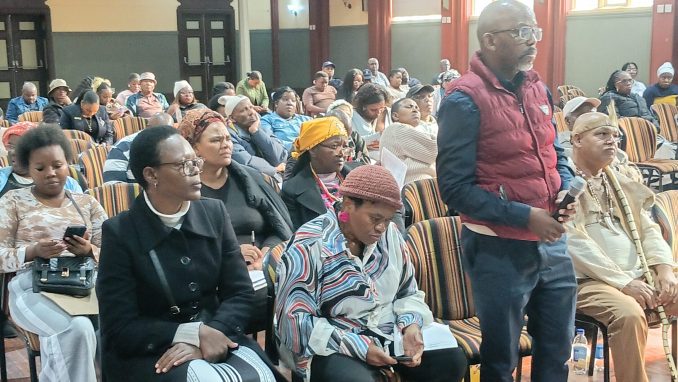

The public hearings on the proposed amendments to the Prevention of Illegal Eviction and Unlawful Occupation of Land Act (PIE) moved to the Eastern Cape this week. On Monday, the sessions were in Mthatha, in KuGompo City Hall on Tuesday, and will be held in Komani and Gqeberha later this week.
The government delegation was led by senior staff from the national and provincial departments of human settlements, and councillors from Buffalo City Metro. The session was chaired by councillor Mike Basopu, who is also the chairperson of the Municipal Public Accounts Committee. The audience was made up of ward councillors, BCMM staff, elderly people who need housing, and ward committees from various communities.
The amendment bill was introduced in parliament by the Democratic Alliance in March 2023 to deal with “illegal land grabs”.
Chief director of legal services at the Department of Human Settlements (DHS), Paul Masemola told the small crowd that the primary purpose of the bill is to repeal the PIE Act of 1998, which was enacted to prevent arbitrary evictions and address historical injustices. “Since the enactment of the PIE in 1998, the country has witnessed a growing number of unlawful occupations of land and buildings,” he said, observing a new trend of high-rise building hijackings in cities where syndicates take advantage of people’s desperate need for housing and lease accommodation that is unsafe and life-threatening.
The opportunists who profit from the hijacking of buildings and the sale of land also benefit from the unlawful evictions of land and buildings. But, according to Masemola, the unlawful occupation of land cannot be tolerated as it may lead to society losing confidence in the laws of the country, scaring off landowners and investors and the jobs they create.
All the government officials on the panel rejected the concerns of civil society and housing groups that the real aim of the amendments is to enable landowners and the state to easily evict poor people from land they occupy.
Programme director for the hearing, Mike Basopu said, “The aim of the DHS is not to criminalise poverty, but at the same time the government cannot allow lawlessness”.

Sodesi Phikisa (77), a resident of Emabhangalweni, a temporary relocation area in Mdantsane, said he has been waiting for a house for over 30 years. “I am attending the session because of the pain of sleeping in the jungle. In 1984, I was staying at Mxilongo in the backyard, since there were no informal settlements allowed back then. I have stayed in various places like Moscow, Gxasheka and Nkandla. I never got a brick house,” said Phikisa.
Nolusapho Gawulani (65), who is originally from Centane but resides at Amabhangalweni, said, “I used to stay at the informal settlement between Xhewu street and the hostels. It is a wetland area and is situated near the river. I was moved by municipal trucks to Emabhangalweni because of my chronic illness. Since 2008, every day I take six pills before I sleep. I have depression and my card is written mental. I have been waiting for a house at Emabhangalweni for about six years now. This is why I am at this housing meeting”
Chief Craig Davids from the Gonaqua royal house, a Khoi-Khoi ethnic group, said that the bill represents the interests of the rich at the expense of poor people. The Khoisan do not even have land to practise their culture, he said. “The bill is not there to support us but to work against the poor. The bill is promoting the capitalists. The landlord will be able to chuck us out the land as they feel, nilly-willy, simply because the government is with them.”
Davids also believes that the courts already grant eviction orders without the provision of alternative accommodation. He mentioned recent examples of evictions that took place in KuGompo City near the airport and Reeston, where people were left homeless and abandoned on the streets, in which the BCMM enlisted the services of Red Ants Security Group, SAPS members and law enforcement teams to assist in executing the court-sanctioned eviction order.
The hearings will be held in Komani on Thursday and in Gqeberha on Friday.